

Schließen

Indian cabinet approves subsidy program for manufacturers of photovoltaic systems
The cabinet approved the subsidies amounting to the equivalent of 607 million US dollars in November 2020. The Ministry of Renewable and New Energy (MRNE), whose proposal for domestic manufacturing of photovoltaic modules was recently approved by the government and its subsidies are now available, will take care of the distribution of the funds. The subsidy program aims to build additional manufacturing capacity of 10,000 MW for photovoltaic systems. In particular, solar modules with high efficiency are to be promoted.

In a national plan, existing manufacturers are to be promoted and dependence on imports reduced. According to an article in the Business Standard, Adani Green, Azure Power, Vikram Solar and Waaree Solar are the leading solar module manufacturers in India. Goldman Sachs-backed renewable energy project developer ReNew Power recently announced its entry into solar cell manufacturing.
According to Waaree Group Managing Director Hitesh Doshi, the incentive program, which is tied to production numbers, will make India’s supply of photovoltaic equipment more self-sufficient and less dependent on imports. Although the subsidies will be available exclusively to domestic manufacturers, Doshi also sees an opportunity to export complete systems or components. Government funds are to be disbursed to manufacturers through a transparent application process. The subsidy period is five years and starts with the commissioning of the production facility and the proven sales of the solar modules. The amount of funding is also dependent on the efficiency of the solar modules and the proportion of materials and components from domestic suppliers.
India has set an ambitious target of 175 gigawatts of renewable energy capacity by 2022. This includes 100 GW from solar and 60 GW from wind. However, most of the current solar energy capacity of 32 GW comes from imported photovoltaic systems. Nearly 75 percent of India’s solar power is based on Chinese solar cells and modules. India’s current solar cell production capacity is 3 GW and 5 GW for modules. India awarded its first solar cell manufacturing tender earlier this year. Under this tender, Adani Green and Azure Power will manufacture solar cells and modules with a capacity of 2 GW and 1 GW, respectively.
The MNRE stated in a recent release that preference will be given to domestically produced solar modules in procurement by central government agencies. As part of the country’s current efforts to ban imports from China, the MNRE has also proposed a 20 percent punitive tariff on imports of solar cells and modules.
In India, photovoltaic systems, equipment and components are subject to BIS certification. BIS certification is similar to CE certification but with some important differences. BIS stands for the Bureau of Indian Standards and is India’s national certification body under the umbrella of India’s Ministry of Consumer Affairs, Food & Public Distribution. It is the central awarding body for BIS certification.
Since 2012, the BIS has been gradually expanding the certification catalog and continuously adding additional goods. BIS certification mandatory for many electronic products for industrial and consumer uses. Factory inspections are also required for some products.
If you are interested in understanding what requirements are needed for your product to be imported into India, please do not hesitate to contact us by email or phone at +49-69-271 37 69 261. There is no cost or obligation for us to check for you. If a certification need is discovered we can provide a quotation to make sure that all your certification needs are covered.
If you have any questions you can also use our chat-window in the bottom right. (Please check your browser settings if you can’t see the window)
For more information about BIS certification, please refer to our free brochure “BIS Certification Made Easy“.
IMF sees India as fastest growing economy in fiscal 2022
The Indian economy is expected to grow by 11.5 percent in the coming fiscal year, according to IMF forecasts. With this, the International Monetary Fund (IMF) predicts a strong recovery for the subcontinent and following the drastic negative impact this year due to the Corona pandemic. As countries next in line to increase economic growth in 2021, the IMF lists China at 8.1 percent, followed by Spain (5.9 percent) and France (5.5 percent).
Regarding India, the IMF also revised its estimates for the current year from a decline in economic output of 10.3 percent in the October forecast to just 8 percent as of current data. In 2020, the IMF said China was the only major country to post positive economic growth at 2.3 percent. Next year, the IMF expects the Chinese economy to grow by 5.6 percent. If these current figures are taken into account, India is currently the fastest growing economy in the world.
The IMF’s report, published at the end of January 2021, includes other indicators of the global economy. For example, the IMF estimates that global trade volume will grow by 8 percent this year. The price of oil in 2021 will rise by about 20 percent above the already low level of 2020 but still remain below the average prices of 2019. As trade volumes increase and India becomes more involved in the global trade of goods, product certifications will become increasingly important.
The Indian certification landscape is very difficult to navigate with your different agencies and processes. Do you need or want to know more about AIS/TAC certification for automotive or BIS for electronic and other consumer products, TEC for telecom products, WPC for radio products, or PESO certification for gas or oil industry products? MPR International GmbH – has been assisting market leaders of numerous industries with their certification projects in Asian markets for many years. Thanks to our fast approach and excellent relationships in India, our customers can always meet their deadlines for the start of production or market launch in India. MPR International GmbH will be pleased to advise you regarding India certification and show you the necessary steps without obligation.
If you are interested in understanding what requirements are needed for your product to be imported into India, please do not hesitate to contact us by email or phone at +49-69-271 37 69 261. There is no cost or obligation for us to check for you. If a certification need is discovered we can provide a quotation to make sure that all your certification needs are covered.
If you have any questions you can also use our chat-window in the bottom right. (Please check your browser settings if you can’t see the window)
For more information, please refer to our free brochures:
AIS-Brochure
BIS-Brochure
TEC-Brochure
WPC-Brochure
PESO-Brochure
The Indian market for smartwatches and other wearables is growing in the triple digits
Analysts at IDC, a market intelligence provider, recently released these figures in a report. For example, the market for smartwatches, wristbands, earphones and other wearable electronics, known as wearables, grew 144.3 percent year-over-year. IDC said 36.4 million devices were shipped. India was the only country in the top 20 with triple-digit growth and remains the world’s third-largest market, the report said. IDC estimates that growth was driven by the rising popularity of earbuds and consumers’ shift from traditional watches to smartwatches and wristbands. Both product segments recorded their highest shipments to date in 2020.

Jaipal Singh, IDC India associate research manager (client devices), said last year saw a major shift from wired audio devices to wireless variants. As a result, he expects the market to move toward high-end or feature-rich devices this year. In the case of smartwatches, prices have now fallen to the point where this is no longer a barrier to purchase, Singh added. The design of the new watches is also more appealing to most customers than conventional watches, and vendors will shift their offerings and portfolio accordingly in the coming months, Singh said.
The earbud product category has grown more than threefold in the past year, with 30.4 million units sold. In addition to affordable prices, increased usage outside of entertainment purposes such as video conferencing or distance learning also contributed to the growth. Particularly in demand for earphones were so-called TWS (true wireless stereo) devices, which connect to the music source via Bluetooth and the left and right audio channels produce separate, high-fidelity stereo sound on the earphones without delay. Of all wearables, audio accounted for 86.3 percent in 2020. Indian manufacturer Boat is the clear market leader with more than two-thirds of all headphones and earbuds shipped. Samsung, including its JBL, Harman Kardon and Infinity sub-brands, is in second place and had 14.5 percent market share last year.
In smartwatches, the number of units shipped exceeded 1 million for the first time in the third quarter of 2020. This compares to only 300,000 devices shipped in the same quarter last year. The most popular models of smartwatches in India were the Noise Colorfit pro-2, Realme watch, Apple watch 6 and Amazfit watches. The growing popularity of smartwatches could have an impact on wristband sales, according to IDC analysts. Their shipments fell 34.3 percent year-on-year to 3.3 million devices after peaking in 2019.
Consumer electronics devices such as smartwatches and earbuds require BIS-CRS certification to import or market them in India. MPR International GmbH – India Certification will be pleased to assist you with BIS-CRS certification and is also available to answer any questions you may have.
If you are interested in understanding what requirements are needed for your product to be imported into India, please do not hesitate to contact us by email or phone at +49-69-271 37 69 261. There is no cost or obligation for us to check for you. If a certification need is discovered we can provide a quotation to make sure that all your certification needs are covered.
If you have any questions you can also use our chat-window in the bottom right. (Please check your browser settings if you can’t see the window)
For more information about BIS certification, please refer to our free brochure “BIS Certification Made Easy“.
Car sales in India rise sharply
Due to rising consumer confidence as well as an increased need for a personal mode of transportation in light of the Covid 19 pandemic, passenger car sales in India increased dramatically in February 2021. According to published data from the Indian Society of Automobile Manufacturers (SIAM), sales of passenger cars rose 18 percent to 281,380 vehicles. The figures do not include sales by Tata Motors, as they do no longer submit monthly sales figures to the association. Sales of two-wheelers rose 10 percent to a total of 1,426,865 units, of which 464,744 were scooters and 910,323 were motorcycles. Sales of three-wheelers, on the other hand, fell 34 percent to 27,331 units.

India’s largest automaker, Maruti Suzuki India (MSI), also benefited from rising demand last year. MSI’s models ranked in the top five of the best-selling new cars in India for the fourth consecutive year; in detail, the best-sellers were the Swift, Baleno, Wagon R, Alto and Dzire. The Suzuki Swift compact car ranked first with 172,000 units, followed by the compact Baleno with 163,000. The Wagon R city car ranked third with 160,000 units, while the Alto and Dzire ranked fourth and fifth with 159,000 and 128,000 units sold, respectively. Next after MSI in terms of market share is Hyundai; Tata, Kia and Mahindra are the other top 5 manufacturers.
AIS stands for Automotive Industry Standards, the technical automotive standards for India, while TAC stands for Type Approval Certificate. This kind of automotive product certifiation is conducted by authorities like the International Center for Automotive Technology (iCAT).
Depending on the product category, there are different certification steps. We will be happy to advise you on certification in India like AIS, BIS, WPC, TEC or PESO and are always available to answer your questions.
Please do not hesitate to contact us for further details and consultation. You can contact us via e-mail, or call us (UK: +44 2071931135, Rest of Europe: +49 69 2713769261, US: +1 773 654-2673).
If you have any questions you can also use our chat-window in the bottom right. (Please check your browser settings if you can’t see the window)
You can also check out our free AIS-Brochure, which can be downloaded right here as a PDF file.
Automotive sector suppliers demand long-term planning certainty for legislative changes
In India, suppliers in the automotive sector are demanding a short-term pause in the introduction of new laws and regulations. They are also demanding long-term planning certainty in order to prepare appropriate investments. The president of the industry association ACMA, Deepak Jain, indicated that in the event of a recovery of the Indian economy, automotive suppliers will play an important role. He further said that during the transition of India’s emission standards from BS4 to BS6, the auto industry invested around $10.7 billion to implement the guidelines accordingly. It is estimated that between 40 and 50 percent of this was shouldered by suppliers. As a result, his association, ACMA, which represents India’s major automotive suppliers, is calling for a temporary suspension or postponement of further new regulations.
The financial situation is tight at many companies, leaving no scope for new investments. This is due to a general downturn in the auto industry as well as supply disruptions and production outages due to the COVID-19 pandemic. According to ACMA President Jain, supply chains are currently already overwhelmed even with the lower demand. He suggested a possible solution would be a meeting of other industry associations and the government to come up with a long-term plan. According to his information, companies are also expecting direct support and subsidies from the government during this difficult period. In the last fiscal year, the Indian supplier industry generated a turnover of 49.2 billion US dollars and reported a decrease of 11.7 percent compared to the previous year.
In addition to vehicles as a whole, an increasing number of components in the automotive sector in India must undergo certification before they can be imported or marketed. Recently, some product categories such as rims, tires, automotive glass and electronic components have been added to this mandatory certification. The relevant automotive technical standards, called Automotive Industry Standards or AIS for short, apply to India as a manufacturing location.
AIS stands for Automotive Industry Standards, the technical automotive standards for India, while TAC stands for Type Approval Certificate. This kind of automotive product certifiation is conducted by authorities like the International Center for Automotive Technology (iCAT).
Depending on the product category, there are different certification steps. We will be happy to advise you on certification in India like AIS, BIS, WPC, TEC or PESO and are always available to answer your questions.
Please do not hesitate to contact us for further details and consultation. You can contact us via e-mail, or call us (UK: +44 2071931135, Rest of Europe: +49 69 2713769261, US: +1 773 654-2673). If you have any questions you can also use our chat-window in the bottom right. (Please check your browser settings if you can’t see the window)
You can also check out our free AIS-Brochure, which can be downloaded right here as a PDF file.
Home entertainment steadily on the rise
Amazon’s Fire TV streaming device reported a doubling of media consumption by Indian customers during the past year. Main content in demand was movies, cricket, online games and music. On average, customers consumed three hours of Fire TV and Disney+ Hotstar content daily. Sales of Fire TV in metropolitan areas increased steadily last year. In this regard, Greater Delhi leads followed by Hyderabad, Pune, Chennai, Kolkata and Ahmedabad. Although the company did not give specific sales figures for India, the number of globally active Fire TV customers exceeded 50 million. Amazon released these figures in a report in late January 2021.
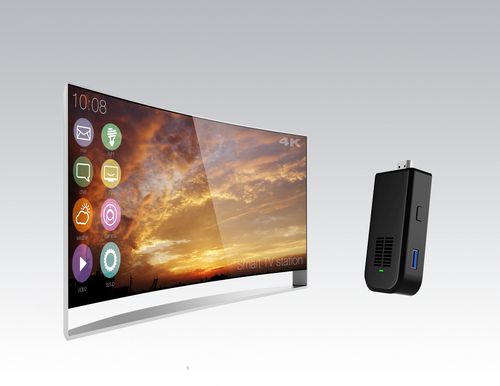
Parag Gupta, Amazon Devices managing director India, said through voice control with Alexa, it has become very easy to find your desired content. Over the past year, a wide range of Fire TV content has been very well received by viewers, including entertainment shows, in-house productions, fitness videos, games and sports broadcasts. In particular, Bollywood movies and Indian soap operas were at the top of Amazon Prime Video, which can be watched via the Fire TV streaming device.
In addition, customers took a liking to games on their Fire TV devices. During the lockdown, time spent playing games doubled, and even after the lockdown ended, consumption is still up 65 percent, according to the Amazon report. Voice search with Alexa increased 70 percent from 2019 to 2020. In addition to entertainment, customers were three times more likely to use fitness and cooking content from Fire TV in 2020 than the previous year. Consumer electronics devices such as the Fire TV Stick require BIS-CRS certification to import or market them in India. MPR International GmbH – India Certification will be pleased to assist you with BIS-CRS certification and is also available to answer any questions you may have.
Since 2012, the BIS has been gradually expanding the certification catalog and continuously adding additional goods. BIS certification mandatory for many electronic products for industrial and consumer uses. Factory inspections are also required for some products.
If you are interested in understanding what requirements are needed for your product to be imported into India, please do not hesitate to contact us by email or phone at +49-69-271 37 69 261. There is no cost or obligation for us to check for you. If a certification need is discovered we can provide a quotation to make sure that all your certification needs are covered.
If you have any questions you can also use our chat-window in the bottom right. (Please check your browser settings if you can’t see the window)
For more information about BIS certification, please refer to our free brochure “BIS Certification Made Easy“.
Motorcycle sales up 8 percent in January
In January 2021, Honda Motorcycle & Scooter India (HMSI) reported an 8 percent increase in their sales figures to a total of 437,183 units. In the same month last year, 403,406 units were sold. Domestic sales totaled 416,716 units in January, up from 374,091 a year earlier. HMSI sales manager Guleria said his company expects double-digit growth this year, making it the top performer in the industry.
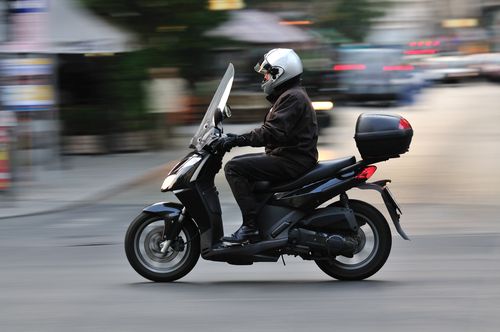
Guleria anticipates an upswing in the fourth quarter of 2021 for a variety of reasons. For one, universities and colleges will reopen, and for another, public life will return to normal due to the Covid-19 vaccination, increasing the demand for two-wheelers to commute in urban areas. Guleria also brought up that the Indian government has announced numerous subsidies for 2021 that will directly or indirectly support the two-wheeler and automotive industries. Among other things, the government has allocated additional funds to develop road infrastructure, launched a program to improve healthcare, increased the price of procuring agricultural produce from farmers and introduced a scrappage scheme. Honda will also unveil a new two-wheeler model this month, which sales manager Guleria says has very good potential to become a big seller.
In India, certification is mandatory for introducing parts or components for two-wheelers to the market. AIS stands for Automotive Industry Standards, the technical automotive standards for India, while TAC stands for Type Approval Certificate. This kind of automotive product certifiation is conducted by authorities like the International Center for Automotive Technology (iCAT).
Depending on the product category, there are different certification steps. We will be happy to advise you on certification in India like AIS, BIS, WPC, TEC or PESO and are always available to answer your questions.
Please do not hesitate to contact us for further details and consultation. You can contact us via e-mail, or call us (UK: +44 2071931135, Rest of Europe: +49 69 2713769261, US: +1 773 654-2673).
If you have any questions you can also use our chat-window in the bottom right. (Please check your browser settings if you can’t see the window)
You can also check out our free AIS-Brochure, which can be downloaded right here as a PDF file.
ICAT, India & MPR International, Germany signed cooperation Memorandum of Understanding (MoU)
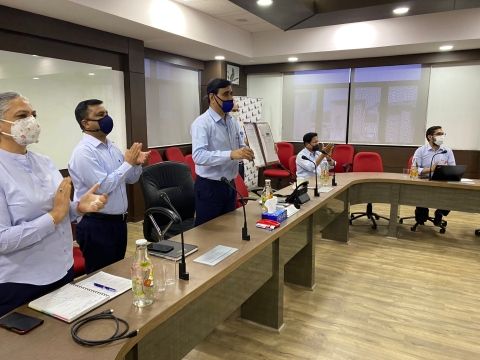
The “International Centre for Automotive Technology”, also known as ICAT, is the leading Indian Testing & Certification Agency for CMVR certification (AIS/TAC) in the Automotive Sector in India. ICAT also regularly conducts tests of automotive & non-automotive components required for Bureau of Indian Standards (BIS) certification.
On April 7, 2021 ICAT, India and MPR International GmbH signed a joint cooperation MoU. The signing ceremony was held via videoconference due to Covid-19 travels restrictions. ICAT’s Director, Mr. Dinesh Tyagi and Managing Director of MPR International GmbH, Mr. Julian Busch signed the MoU. The MoU will result in more cooperation and mutual support in handling of the certification business. MPR International is now an official partner of the Indian Testing & Certification Agency, ICAT.
Together, ICAT and MPR International GmbH will work to expand their existing services for the certification of automotive products in India and thus extend the overall scope of services for their customers with the common goal to provide a framework for the future advancement of automotive technology.
ICAT’s Director Mr. Dinesh Tyagi and his colleagues during the MoU signing ceremony.
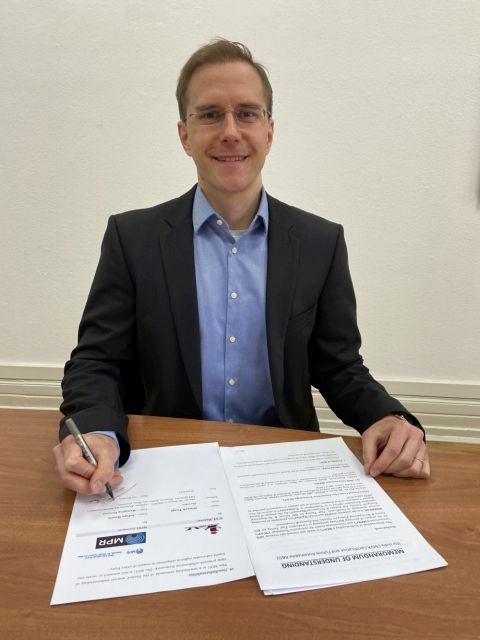
Managing Director Mr. Julian Busch of MPR International GmbH during the MoU signing ceremony.
Since 2006, ICAT (https://www.icat.in/) is authorized by Ministry of Road Transport & Highways (MoRTH), Govt. of India to conduct automotive certifications. According to the Central Motor Vehicles Rules (CMVR), ICAT is authorized to issue approvals of vehicles and their components as per respective notified Indian Standards. In addition, ICAT is also authorized to carry out the testing and approval of other products such as generators, non-automotive products like IT Products, General Lightings, White Goods, Architecture Glasses etc.
ICAT offers high-quality and comprehensive services for International clients also and ensures all quality standards for approvals.
MPR International GmbH supports customers world-wide with various certifications for the Asian market. For India, these currently include AIS/TAC, BIS, WPC, TEC and PESO certifications. AIS certification is required for automotive components, while electronic components require BIS certification, WPC for wireless products, TEC for telecommunications products and PESO in the petroleum and explosive and safety areas.
MPR enables its customers to access the Indian market through its versatile certification services for all product areas. MPR has gained particular expertise in the Automotive, Electrical, Mechanical Engineering, Telecommunications and IT Sectors.
Since 2019, India has identified more and more products, requiring mandatory certification. At the same time, more companies are looking to sell products in the Indian market. Due to the complex certification process and new regulations many companies have questions and concerns on how to enter into the market? With closer cooperation between ICAT and MPR, we offer our customers a simplified solution in the certification process.
Certification for Helmets will now be Mandatory
The Indian Standard IS4151:2015 applying to Helmets for riders of two-wheel motor vehicles has been changed to compulsory certification status. Until now, the respective helmets could be certified voluntarily. However, after consultation with the BIS (Bureau of Indian Standards) the Indian government is of the opinion that it is in the public’s interest to change this.
The BIS (Bureau of Indian Standards) will stay the certifying and enforcing authority for the applicable products and standard. The mandatory certification requires multiple steps before a product can be imported, including product tests in India as well as a factory audit.
The change will go into effect in June 2021 and applies to the following product types:
| Goods or Articles | Indian Standard | Title of Indian Standard |
| (2) | (3) | (4) |
| Helmet for riders of two-wheeler motor vehicles | IS 4151: 2015 | Protective Helmet for two-wheeler Riders |
Since the list is constantly changing and expanding, it is often not clear whether a product is subject to certification or not.
We can help you here and provide reliable information about the regulations for your product.
We are happy to support you with BIS Certification and are available at any time to answer any questions you may have. Write us an email or call us at +49-69-2713769261.
If you have any questions you can also use our chat-window in the bottom right. (Please check your browser settings if you can’t see the window)
Reduction in import duties for steel products cheers steel industry and importers
The Indian Ministry of Finance announced in February that it would reduce customs duties on imports of certain steel products from 12.5 percent to 7.5 percent, and steel scrap will be completely exempt from customs duties on imports. For steel scrap, the tax reduction will be in effect until March 31, 2022; the Ministry of Finance did not specify a fixed date for the other categories. The products included in the duty reduction are semi-finished products, flat and rod steels made of pure metals, alloys and stainless steel. In addition, to support steel recycling companies, the customs duties on copper scrap will be reduced from 5 percent to 2.5 percent.
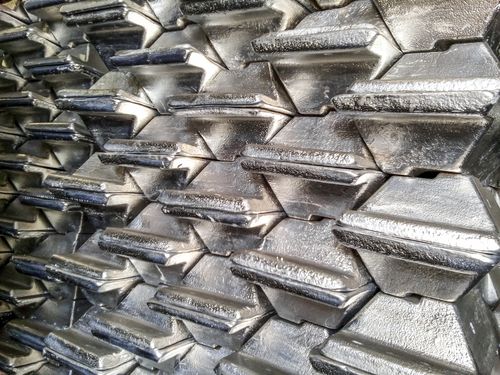
The Ministry of Finance cited the sharp rise in steel prices on the Indian market as the reason for the reduction in customs duties. In some cases, price increases of up to 50 percent were observed. To further ease the situation, previous regulations such as punitive and countervailing duties on some products and countries of origin such as China were also temporarily suspended until Sept. 30, 2021. The products affected for the suspension of punitive duties are rod steel from China, HSS steel from Brazil, China and Germany, and flat and coated steel from China, Vietnam and Korea. Countervailing duties have been temporarily suspended on rolled stainless steel products from China and flat stainless steel from Indonesia.
The Indian steel industry and importers were pleased with the news from the Finance Ministry. Chief Executive Officer of Usha International, a manufacturer of home appliances, Dinesh Chhabra said, “The temporary suspension of duties on steel and copper scrap until March 2022 will help us keep prices stable for end users and achieve good sales in the current year.” For importers of steel products, the reduction in tariffs will also have a positive impact. It should be noted, however, that steel products need BIS-ISI certification to be imported into India. BIS stands for the Bureau of Indian Standards and is India’s national certification body under the umbrella of the Indian Ministry of Consumer Affairs, Food & Public Distribution. Product certification under the Bureau of Indian Standards (BIS) has been in existence since July 2013 and is intended to be an assurance of quality, safety and reliability to third parties. ISI is the mark or seal on the respective product. The ISI mark was introduced by the BIS for industrial products in 1955. MPR International GmbH – India Certification will be pleased to assist you with BIS-ISI certification and is also available to answer any questions you may have.
Since 2012, the BIS has been gradually expanding the certification catalog and continuously adding additional goods. BIS certification mandatory for many electronic products for industrial and consumer uses. Factory inspections are also required for some products.
If you are interested in understanding what requirements are needed for your product to be imported into India, please do not hesitate to contact us by email or phone at +49-69-271 37 69 261. There is no cost or obligation for us to check for you. If a certification need is discovered we can provide a quotation to make sure that all your certification needs are covered.
If you have any questions you can also use our chat-window in the bottom right. (Please check your browser settings if you can’t see the window)
For more information about BIS certification, please refer to our free brochure “BIS Certification Made Easy“.
 We are part of the CERTANIA-Group.